Senin, 23 Juli 2007

Open Market Operations: Key Concepts


  • Temporary open market operations involve repurchase and reverse repurchase agreements that are designed to temporarily add or drain reserves available to the banking system.
  • Permanent open market operations involve the buying and selling of securities outright to permanently add or drain reserves available to the banking system.
  • The federal funds rate is the interest rate at which depository institutions lend balances at the Federal Reserve to other depository institutions overnight.

Role of Central Banks


Despite the size and importance of the foreign exchange market, it remains largely unregulated. There is no international organization that supervises it, nor any institution that sets rules. However, since the advent of the flexible exchange rate system in 1973, governments and central banks, such as the Federal Reserve System in the United States, occasionally intervene to maintain stability in the FX market.

There is no standard definition of instability or a disorderly market—circumstance must be evaluated on a case-by-case basis. Sharp rapid fluctuations of exchange rates and traders’ reluctance to be ready to either buy or sell currencies (maintaining a "two-way" market) may be signs of disorderly market.

To restore stability, the central banks often work together. However, a country taking a conservative view on intervention would act only in response to unusual circumstances that require immediate action, like political unrest or natural disasters. Most monetary authorities would be less likely to intervene to counteract the fundamental forces that drive FX markets, such as trade patterns, interest rate differentials and capital flows

Intervention

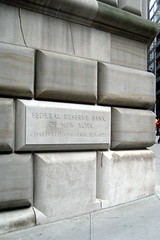
The U.S. Treasury has the overall responsibility for managing the U.S. government’s foreign currency holdings. It works closely with the Federal Reserve to regulate the dollar’s position in the FX markets. If the Treasury feels that there is a need to weaken or strengthen the dollar, it instructs the Federal Reserve Bank of New York to intervene in the FX market as Treasury’s agent. The Federal Reserve uses the Exchange Stabilization Fund (ESF) to finance these interventions. Learn more about the ESF offsite.

The Federal Reserve Bank of New York buys dollars and sells foreign currency to support the value of the dollar. The Fed also sells dollars and buys foreign currency to try and exert downward pressure on the price of the dollar.

The transactions in the intervention are small compared to the total volume of trading in the FX market and these actions do not shift the balance of supply and demand immediately. Instead, intervention is used as a device to signal a desired exchange rate movement and affect the behavior of investors in the FX market.

The frequency of intervention in the FX markets by the U.S. monetary authorities has reduced tremendously over the last decade. The Federal Reserve Bank of New York intervened only twice since 1995.

Central banks in other countries have similar concerns about their currencies and sometimes intervene in the FX markets as well. Usually, intervention operations are undertaken in coordination with other central banks.

Most of the Federal Reserve Bank of New York’s activities in the foreign exchange market are for far less dramatic purposes than to influence exchange rates. The New York Fed often intervenes in the FX market as an agent for other central banks and international organizations to execute transactions related to flows of international capital.

Learn more about the Federal Reserve Bank’s role in the FX market.

Some countries have special arrangements with other countries to help them keep their currencies stable. Many less developed countries have their soft currencies pegged to hard currencies, so their value rises and falls simultaneously with the stronger currency. Some peg, or target, their currency to a basket of hard currencies, the average of a group of selected currencies.

Countries that are part of the European Union (EU) had pegged their currencies to the euro. There were formulas set for converting from the euro to the currency of each member nation. However, since January 2002, all currencies that were part of the Economic and Monetary System of the EU ceased to exist.

Intervention in the FX market is not the only way monetary authorities can affect the value of their countries’ currencies. Central banks can also affect foreign exchange rates indirectly by influencing interest rates.

Higher interest rates è
Value of currency goes up
è Investors want to buy currency
to invest at high rates
German interest rate è
8%
U.S. interest rate
3%
è Demand for German mark goes up


Concerns about Eurocurrency
An important side effect of the increase of international economic activity over the past few decades has been the creation and growth of the Eurocurrency market. This is the name given to any bank deposits in any country held in a different country’s currency, like U.S. dollars in a British bank. A great deal of foreign exchange market activity involves the transfer of Eurocurrency deposits.

Eurocurrency, especially eurodollars (approximately two-thirds of Eurocurrency are U.S. dollars) are a source of concern to central banks and regulators because they are "stateless money"—subject to very little regulation. Rules governing currency and bank deposits— such as taxes, restrictions on capital movements and exchange controls—do not apply to the currency in the Eurocurrency markets.

Banks around the world use the Eurocurrency market to move and store funds more profitably than they could in many countries. This poses a problem for countries attempting to regulate capital flows.

International trade and foreign exchange cannot be viewed as two separate economic processes. The two are intimately connected on many levels. Increased trade and investment has brought the FX markets to their present level. Together, trade and foreign exchange affect peoples’ living standards and livelihoods all over the world.

Jumat, 20 Juli 2007

The "upstairs market"


Recent research by Kumar Venkataraman, finance professor at SMU's Cox School of Business, and Hendrik Bessembinder offers insight and evidence into new possibilities and difficult issues facing stock exchanges. In “Does an electronic stock exchange need an upstairs market?” from the July, 2003 issue of Journal of Financial Economics, the authors find that a large proportion of institutional trading in electronic exchanges is executed away from the centralized book in the informal 'upstairs market', thus presenting new challenges.

Despite the efficiencies of computerized markets, virtually every stock market is accompanied by a parallel "upstairs" market, where larger traders employ the services of brokerage firms to locate counterparties and negotiate trade terms. Upstairs markets are based on relationships. Rather than submitting an electronic order to effortlessly attract counterparties, the upstairs brokers seek out counterparties (from traders known to them who might be interested). They then negotiate transactions that might otherwise be executed at an inordinate cost or delay. An electronic trading system lowers the fixed costs of trading for relatively liquid stocks in block sizes not likely to overwhelm the current market. However, it does not allow for the informal exchange of information (?) that is important for certain types of large trades and for illiquid stocks.

In electronic markets, traders don’t get a sense of who they’re trading with, how much more the other party is trading, etc., and that information can be very important to some traders. Large (institutional) traders therefore seek other trading venues such as the 'upstairs market' to lower the risk of exposing their order positions, to ensure symmetric transfer of information, and to retain some of the give and take of the old open outcry market. Approximately 70% of block-size trade transactions are executed in the upstairs market in Paris.

The Paris Bourse provides an excellent illustration of the use of upstairs intermediation markets, because its electronic limit order market closely resembles the downstairs (electronic) markets envisioned by theorists. The best evidence from the Paris Bourse is that:

  1. Upstairs brokers lower the risk of adverse selection by "certifying" block orders as uninformed (i.e., as not having access to nonpublic information).
  2. Upstairs brokers are able to tap into pools of hidden or unexpressed liquidity (they frequently 'go looking' for buyers or sellers not currently in the market).
  3. Traders strategically choose across the upstairs and downstairs markets to minimize expected execution costs (including slippage, etc.).
  4. Trades are more likely to be routed upstairs if they are large or are in stocks with low overall trading activity.

The second result is the most novel and arguably the most important. The upstairs broker completes transactions by searching for institutional investors who may be interested in the stock, but who have not as yet formally expressed their trading intentions. It is documented that executions costs of transactions completed by the upstairs broker average only 35% of what they would have paid if completed against limit orders in the centralized electronic exchange, suggesting that trading relationship and the informal exchange of information between upstairs brokers and institutional traders helps lower execution costs. One major challenge facing electronic markets is the lack of a comparable mechanism of certification of traders and information exchange.

The Euronext market allows large transactions in some stocks to be executed outside the quotes. Such outside-the-quote transactions are not permitted in United States markets. For eligible stocks in Paris, market participants agree to outside-the-quote execution mainly for more difficult trades and at times when downstairs liquidity is lacking. These likely represent trades that probably could not have been otherwise completed, suggesting that market quality can be enhanced by allowing participants more flexibility to execute blocks at prices outside the quotes. These findings are particularly relevant to U.S. markets because quoted spreads and depths have decreased substantially in the wake of decimalization.

The upstairs market in the Paris Bourse completes two-thirds of block trading volume, compared with 20% on the New York Stock Exchange (NYSE). A likely explanation is that the NYSE floor allows large traders to execute customized strategies through a floor broker, while avoiding the risks of order exposure. If orders submitted to electronic markets do not allow block initiators to limit order exposure and trade strategically, then order flow is likely to migrate to alternative trading venues such as the upstairs market. If you’re a liquidity trader, you don’t want the system to be anonymous. If you’re an informed trader you like anonymity because you can hide in the order flow.

To compete with broker-intermediated markets, the next generation of electronic trading systems needs to include features that better meet the needs of large traders, particularly the lack of anonymity. To allow large investors to manage order exposure in an electronic exchange, a wider range of order types that include state contingent exposure and execution algorithms need to be made available. The NYSE’s recently introduced “Conversion and Parity” (CAP) orders which are intended to be “smart” orders for large lots of stocks that are executed gradually through the day, contingent on market conditions, are a step in this direction.

The future of stock exchanges in the United States


The future of stock trading appears to be electronic, as competition is continually growing between the remaining traditional New York Stock Exchange specialist system against the relatively new, all Electronic Communications Networks, or ECNs. ECNs point to their speedy execution of large block trades, while specialist system proponents cite the role of specialists in maintaining orderly markets, especially under extraordinary conditions or for special types of orders.

The ECNs contend that an array of special interests profits at the expense of investors in even the most mundane exchange-directed trades. Machine-based systems, they argue, are much more efficient, because they speed up the execution mechanism and eliminate the need to deal an intermediary.

Historically, the 'market' (which, as noted, encompasses the totality of stock trading on all exchanges) has been slow to respond to technological innovation. Conversion to all-electronic trading could erode/eliminate the trading profits of floor specialists and the NYSE's "upstairs traders."

William Lupien, founder of the Instinet trading system and the OptiMark system, has been quoted as saying "I'd definitely say the ECNs are winning... Things happen awfully fast once you reach the tipping point. We're now at the tipping point."

Congress mandated the establishment of a national market system of multiple exchanges in 1975. Since then, ECNs have been developing rapidly.[citation needed]

One example of improved efficiency of ECNs is the prevention of front running, by which manual Wall Street traders use knowledge of a customer's incoming order to place their own orders so as to benefit from the perceived change to market direction that the introduction of a large order will cause. By executing large trades at lightning speed without manual intervention, ECNs make impossible this illegal practice, for which several NYSE floor brokers were investigated and severely fined in recent years.[citation needed] Under the specialist system, when the market sees a large trade in a name, other buyers are immediately able to look to see how big the trader is in the name, and make inferences about why s/he is selling or buying. All traders who are quick enough are able to use that information to anticipate price movements.

ECNs have changed ordinary stock transaction processing (like brokerage services before them) into a commodity-type business. ECNs could regulate the fairness of initial public offerings (IPOs), oversee Hambrecht's OpenIPO process, or measure the effectiveness of securities research and use transaction fees to subsidize small- and mid-cap research efforts.

Some[attribution needed], however, believe the answer will be some combination of the best of technology and "upstairs trading" — in other words, a hybrid model.

Trading 25,000 shares of Lucent stock (recent[when? ] quote: $2.80; recent[when? ] volume: 49,069,700) would be a relatively simple e-commerce transaction; trading 100 shares of Berkshire Hathaway Class A stock (recent quote: $88,710.00; recent volume: 450) may never be. The choice of system should be clear (but always that of the trader), based on the characteristics of the security to be traded.

Even with ECNs forming an important part of a national market system, opportunities presumably remain to profit from the spread between the bid and offer price. That is especially true for investment managers that direct huge trading volume, and own a stake in an ECN or specialist firm. For example, in its individual stock-brokerage accounts, "Fidelity Investments runs 29% of its undesignated orders in NYSE-listed stocks, and 37% of its undesignated market orders through the Boston Stock Exchange, where an affiliate controls a specialist post."

Fidelity says these arrangements are governed by a separate brokerage "order-flow management" team, which seeks to obtain the best possible execution for customers, and that its execution is highly rated.[citation needed]

Kamis, 19 Juli 2007

The Main Activator of Foreign Exchange Market


Foreign exchange market have the rotation about more than 2 billion U.S Dollar in every day, is the biggest finance market in the world. This value is about 3 times from United States Stock Exchange Alliance or about 5300 times from Jakarta Stock Exchange in every day. By the large value market, and also very dynamic movement, sometimes people ask the question what cause foreign currency market moving so dynamic, volatile repeatedly, with the rotation non stopping 24 hours in a day.
In summarized, can be told that any movement market will be influenced by demand and supply in market. So that way with this foreign currency market, sometimes demand and supply factors will be reacting to news or economic data.
In the world of foreign exchange movement, therefore US. Dollar is the dominant market over. As a country with the biggest economics in the world and Dollar become couple rate about 90 % from world currency, so it is nature that U.S Dollar movement will be influencing many others currency. Thereby, economics data U.S too important to keep corrected because it will be determining demand and supply level and foreign currency market finally.
Economics Data U.S usually released on correct schedule in every month, with to keep accurate data before released timely. That data is fundamental factors that will influenced market. By many in research institution , or news (like Bloomberg, CNBC, Reuters, and others). Sometimes have been predicted through consensus many economic expert before released by Government Institutions officially. Foreign Exchange market sometimes begins moving before official data released that have related to forecast data or prediction.
While among many economics data U.S which estimating just have strong influence to U.S Dollar fluctuation, and therefore, foreign exchange in global? Through many experience in foreign currency market and research in many private institution foreign exchange, therefore many data that corrected to read because of large influence to market is :


No Economics Indicator Explanation
1 Non-Farm Payrolls Describe about the numbers of new labour additions into formal sector (non-farm sector). Increase of labour addition usually have positive influence to U.S Dollar.
2 Interest Rates Decision represent from The Fed or The Federal Open Market (FOMC), to interest rates, increased or fixed generally. Interest rates increase decision will strengthen U.S Dollar.
3 Trade Balance Data from (deficit) U.S Trade Balance. It deficit increase will badness influential to U.S Dollar.
4 Inflation (CPI) Data represent about U.S inflation level, especially from consumer (Consumer Price Index). That data to indicate inflation increase will strengthen U.S Dollar through market expectation that The Fed will raise interest rates to against this inflation.
5 Retail Sales Data about U.S retailing. It addition will affected strengthen to U.S Dollar.
6 Foreign Purchases of US Treasures (TIC) This data shown U.S treasures by foreign investor. Addition this treasures will affected strengthen to U.S Dollar.
7 ISM Manufacturing Institute for Supply Management - Manufacturing, United index which shown U.S performance manufacturing from demand and supply side.
Increasing this data will positive affecting to U.S Dollar.
8 PPI This data represent inflation level in U.S from seller side. Like CPI, inflation increase indicator will answered by bullish sentiment for U.S Dollar.
9 Personal Consumption This data represent public consumption expenditure. It increase tend to affected strengthen to U.S Dollar.
10 Durable Goods This data describe demand level for durable goods. It increase usually positive affected to U.S Dollar.

If you want to know more information about fundamental analyze containing economic data history, click the calendar and the prediction, try to visit at www.forexfactory.com; www.bloomberg.com; www.forexnews.com; and www.reuters.com
Despitefully on website, you can conduct simulation on trading without having to put into a number of funds. This simulation is represent as practice on foreign exchange trading.

By: Helmi Nugroho Ariansyah
Foreign Exchange Analyst

When Foreign Currency Exchange To Be Investment Alternatif


What is Foreign Exchange? Foreign Exchange is the biggest market in the world, where a currency is traded to another currency, for example Euro to U.S Dollar or Dollar Australia to Yen Japan. This foreign exchange has been traded at least US$ 2 billion every day in market until now. Amount this fund almost equivalent by United States Bruto National Product for 1 year.
There are some excess which on the market if investor have investment to foreign exchange (currency) market ? :
First, investment expense early is small relative compared than real business, because investor in this case do not require supporting facilities in the form of building, factory, and machines. Even many employee do not needed in this business, because this business can be run by yourself without oyhers aid.
Beside of that comission in foreign exchange is small relative compared than expense which must be released you want investment in property sector, where is the investor must have spent administration fee or taxes.
Second, foreign exchange market is the biggest place and likuid in the world of business. Because this condition so there is no one can be influence movement of currency exchange rate in market.
Third, investor get profit directly when up trend (bullish market), but also market when down tren (bearish market). Investor get two opportunity of profit at the same time (two-way opportunities). So this is an big excellence which do not have by investor which investment in stock exchange or property sector.
Fourth, while other excess is time. Foreign exchange market open non stopping in 24 hours each day. So investor can decide work hours according to theirself. In another word, investment in foreign exchange can be exploited some of investor as peripheral business, after main job finished.
Fifth, techninal analyze very compatible is applied in foreign exchange market and the tren usual clearly. This analyze can be learned to all investor in a short time, so long they have desire to know more deep.
Sixth, foreign exchange market offering leverage or energy lever up equal to 100 comparing one. In this case investor only need small equity to investment.
Seventh, investor get more enough money by hard working many hours each day or each week. Example, 50 point in foreign exchange market have same point with US$ 500. Every day, almost have gyration difference-between lowest price to highest price in Euro, Yen Japan, and Poundsterling currency (exchange rate) get more than 50 point.

More Dynamic
Eighth, if investor conduct transaction from anywhere and anytime, as long commuications network via internet was available. Currency transactions by via internet is more efficient from than cost and time.
Ninth, if investor decide to investment in many main currency is more benefit than other currency. So, what kind of main currency that can be made reference in your transaction ? I think much better, if you try transaction in U.S Dollar, Poundsterling, Yen Japan, Euro.
Tenth, you can be control capital loss in foreign exchange market by placed stop loss at the time when we get into market and open new position. Intention of stoping the loss is to limit when market movement at variance with investor position, and then secure capital on a long term.

If you want to know more information about fundamental analyze containing economic data history, click the calendar, and the prediction, try to visit at www.forexfactory.com; www.bloomberg.com; www.forexnews.com; and www.reuters.com
Despitefully on website, you can conduct simulation on trading without having to put into a number of funds. This simulation is represent as practice on foreign exchange trading.

By: Helmi Nugroho Ariansyah
Freelance Foreign Exchange Analyst

Retail forex


From Wikipedia, the free encyclopedia

The Retail forex (Retail Currency Trading or Retail Forex or Retail FX) market is a subset of the much larger Foreign exchange market. The Foreign Exchange market trades around 1.9 trillion daily, and retail trading is about 20 - 25 billion of that volume.

History

Retail trading, is more structured than the forex market as a whole.[citation needed] While forex has been traded since the beginning of financial markets, modern retail trading has only been around since about 1996 . Prior to this time, retail investors were limited in their options for entering the forex market. They could create multiple bank accounts, each one denominated in a different currency, and transfer funds from one account to another in order to profit from fluctuating exchange rate. This was troublesome, however, because the transaction costs incurred were large due to the small quantity of funds being converted relative to the size of the market. This transaction type was at the very bottom of the forex pyramid.

By 1996, new market makers took advantage of developments in web-based technology that made retail forex trading practical. These internet-based market makers would take the other side of retail trader’s trades. The new companies felt that there was enough liquidity in the forex market, and eventually within their own customer base, to guarantee markets under all but the most unusual market conditions. These companies also created online trading platforms that provided a quick and easy way for individuals to buy and sell on the Forex Spot market. In addition, the companies realized that by pooling many retail traders together, they had the size to enter the upper echelons of the forex market, which reduced the size of the spread. As the business grew, the market makers were given better prices, which they then passed on to the customer.

Market makers got around this issue by allowing customers to inflate all movements many times over. In the world of online currency exchange, no transaction actually leads to physical delivery to the client; all positions will eventually be closed. The market makers are therefore able to offer high amounts of leverage. While up to 4:1 leverage is available in equities and 20:1 in Futures, it is common to have 100:1 leverage in currencies; some forex market makers offer up to 400:1. In the typical 100:1 scenario, the client absorbs all risks associated with controlling a position 100 times the capital they are putting up, and, given that the money is only being used for currency exchange and on the market makers’ books, the transaction can proceed.

Current spreads for the most common currency pair, EUR/USD, is typically 3 pips (3/100th of a percent). An equivalent trade using a bank account would most likely be between 200 and 500 pips, while an equivalent trade using cash at an exchange institution would be around 750 – 2500 pips.

Currencies are quoted in pairs i.e. EUR/USD (Euro vs. United States Dollar). Out of convention, the currency quoted first was the stronger currency at the time of inception.
Top 6 Most Traded Currencies Rank Currency ISO 4217 Code Symbol
1 United States dollar USD $
2 Eurozone euro EUR €
3 Japanese yen JPY ¥
4 British pound sterling GBP £
5-6 Swiss franc CHF -
5-6 Australian dollar AUD $

[edit] Key Concepts Behind A Retail Forex Trade

[edit] Retail Forex Trading

As previously mentioned, currencies fluctuate relative to other currencies. Take two of the most common currency pairs, the EUR/USD (the price for Euros in US dollars) and the GBP/USD (the price for The Great British Pound in US dollars). If there is positive economic news in the Euro zone and negative economic news in the United Kingdom, it is very conceivable that the EUR/USD would go up in value, meaning it is now more expensive in US dollars to purchase one EUR, and that the GBP/USD would go down in value, meaning it is now cheaper to buy Great British Pounds with US dollars. In this scenario, the US dollar went up in value against one currency and down in relation to another. It is important to understand this idea that currency pairs move mostly independently from one another. Currency pairs with similar currencies on one side (like the USD in the previous example) can be similarly affected by news regarding the common currency, but the crucial concept is that they don’t have to be.

[edit] Retail Forex is usually highly leveraged

The idea of margin (leverage) and floating loss is another important trading concept and is perhaps best understood using an example. Most retail Forex market makers permit 100:1 leverage, but also, crucially, require you to have a certain amount of money in your account to protect against a critical loss point. For example, if a $100,000 position is held in Eur/USD on 100:1 leverage, the trader has to put up $1,000 to control the position. However, in the event of a declining value of your positions, Forex market makers, mindful of the fast nature of Forex price swings and the amplifying effect of leverage, typically do not allow their traders to go negative and make up the difference at a later date. In order to make sure the trader does not lose more money than is held in the account, Forex market makers typically employ automatic systems to close out positions when clients run out of margin (the amount of money in their account not tied to a position). If the trader has $2,000 in his account, and he is buying a $100,000 lot of EUR/USD, he has $1,000 of his $2,000 tied up in margin, with $1,000 left to allow his position to fluctuate downward without being closed out.

Typically a trader's trading platform will show him three important numbers associated with his account: his balance, his equity, and his margin remaining. If trader X has two positions: $100,000 long (buy) in EUR/USD, and $100,000 short (sell) in GBP/USD, and he has $10,000 in his account, his positions would look as follows: Because of the 100:1 leverage, it took him $1,000 to control each position. This means that he has used up $2,000 in his margin, out of a $10,000 account, and thus he has $8,000 of margin still available. With this margin, he can either take more positions or keep the margin relatively high to allow his current positions to be maintained in the event of downturns. If the client chooses to open a new position of $100,000, this will again take another $1,000 of his margin, leaving $7,000. He will have used up $3,000 in margin among the three positions. The other way margin will decrease is if the positions he currently has open lose money. If his 3 positions of $100,000 decrease by $5,000 in value (not at all an unusual swing), he now has, of his original $7,000 in margin, only $2,000 left. As discussed above, if you have a $10,000 account and only open one $100,000 position, this has committed only $1,000 of your money plus you must maintain $1,000 in margin. While this leaves $9,000 free in your account, it is possible to lose almost all of it if the position dives. On the other hand, if you have 5 positions open in a $10,000 account, you can lose only $5,000 because the other $5,000 is held in margin. However, this does not make it safer to hold more positions. The Forex market fluctuates so rapidly, that with shallow margins, you are much more likely to be closed out of your position and lose it entirely when it might have recovered from a temporary fluctuation if you had had sufficient margin to cover the variation. The more positions open at one time, the more risk the trader is exposed to.

[edit] Transaction costs and market makers

Market makers are well compensated for allowing retail clients to enter the Forex market. They take part or all of the spread in all currency pairs traded. In a common example, EUR/USD, the spread is typically 3 pips (3/100 of a percent). Thus prices are quoted with both a Buy and Sell price (e.g., Buy Eur/USD 1.2000, Sell Eur/USD 1.2003). That difference of 3 pips is the spread and can amount to a significant amount of money. (Note: the spread is only taken out at the beginning of the trade; this transaction cost is subtracted only upon entering the trade, not leaving it) Because the typical standard lot is 100,000 units of the base currency, those 3 pips on EUR/USD translate to $30 paid by the client to the market maker. However, a pip is not always $10. A pip is 1/100th of a percent, and the currency pairs are always purchased by buying 100,000 of the base currency, which is also known as the counter currency. For the pair EUR/USD, the base currency is USD; thus, 1/100th of a percent on a pair with USD as the base currency will always have a pip of $10. If, on the other hand, your currency has Swiss Frank (CHF) as a base instead of USD, then 1/100th of a percent is now worth around $8, because you are buying 100,000 worth of Swiss Franks.

If a trader with a $10,000 account on 100:1 leverage felt, after reading reports on the economy, that the USD was going to go up in value against the EUR and the CHF, he would Sell EUR/USD (thus selling EUR and buying USD) and Buy USD/CHF (buying USD and selling CHF). The transaction is all electronic, so the trader doesn’t need to have Euros in his account. On a large scale, the market maker can sell Euros on behalf of the trader, knowing that the position will eventually be closed and converted back to USD. Assume that the client sold 100,000 EUR/USD at 1.2000 and bought 100,000 USD/CHF at 1.2500. Seconds after this transaction, his account would read: Balance: $10,000, Equity $9,946. The loss of $54 is due to the transaction cost taken only at the entry of a position of 3 pips, which translates to $30 for the EUR/USD pair and $24 for the USD/CHF pair. With equity of $9,946 on 100:1 leverage with 2 positions opened, $2,000 is now held in margin, leaving the trader $7,946 in usable margin. Suppose the EUR/USD (sold at 1.2003) starts to move against the trader and goes up in value to 1.2013, while the USD/CHF (bought at 1.2500) starts moving for the client and also goes up in value to 1.2515. His account information will have changed but his balance and margin will remain unchanged at $10,000 and $2,000 respectively. His equity and his usable margin, however, will change to reflect the new market conditions. While for the trader, the platform will calculate this all automatically, it is important to see it step by step.

Beginning Summary
Client Account: XXX
Balance $10,000
Equity: $ 10,000
Usable Margin: $10,000
Used Margin: $0

Step 1: Client XXX places two trades.
Sells 1 standard lot EUR/USD (100,000 worth of the base currency -- USD)
Buys 1 standard lot of USD/CHF (100,000 worth of the base currency – CHF)

Balance remains: $10,000
Equity: $9,946 (roughly, due to transaction costs of 3 pips each. $30 – EUR/USD transaction cost $24 USD/CHF transaction cost---the difference is due to difference in pip value)
Usable Margin: $7,946
Used Margin $2,000

Step 2: Market Conditions Change, with EUR/USD going up 10 pips (a 10 pip decrease in value to the client, since he is short EUR/USD), while the USD/CHF has increased in value by 15 pips.

EUR/USD pair has lost 10 pips, with each pip $10 so it has lost $100
USD/CHF has gained 15 pips, with each pip around $8 so it gained $120
The difference is now +$20

Balance: $10,000
Equity: $9,966
Usable Margin: $7966
Used Margin: $2000

Step 3: Client closes both positions (by performing the opposite trade – Buying EUR/USD and Selling USD/CHF). He now has no positions in the market, and his money is no longer fluctuating with the market.

Balance: $9,966
Equity: $9,966
Usable Margin: $9,966
Used Margin: $0

[edit] Financial Instruments

There are several types of financial instruments commonly used.

Forwards: One way to deal with the Forex risk is to engage in a forward transaction. In this transaction, money does not actually change hands until some agreed upon future date. A buyer and seller agree on an exchange rate for any date in the future, and the transaction occurs on that date, regardless of what the market rates are then. The duration of the trade can be a few days, months or years.

Futures: Foreign currency futures are forward transactions with standard contract sizes and maturity dates — for example, 500,000 British pounds for next November at an agreed rate. Futures are standardized and are usually traded on an exchange created for this purpose. The average contract length is roughly 3 months. Futures contracts are usually inclusive of any interest amounts.

Swaps: The most common type of forward transaction is the currency swap. In a swap, two parties exchange currencies for a certain length of time and agree to reverse the transaction at a later date. These are not contracts and are not traded through an exchange.

Spot: A spot transaction is a two-day delivery transaction, as opposed to the Futures contracts, which are usually three months. This trade represents a “direct exchange” between two currencies, has the shortest time frame, involves cash rather than a contract; and interest is not included in the agreed-upon transaction. The data for this study come from the Spot market.

[edit] The Difference between Spot and Futures in Forex

Before a description of retail trading, it is important to understand the difference between the Spot and Futures markets. Futures are generally based on contracts, with typical durations of 3 months. Spot, on the other hand, is a two-day cash delivery. While the Futures markets was created to hedge out risks and speculate on future market conditions, Spot was created to allow actual cash deliveries. Spot developed a two-day delivery date in order to give those transporting the actual cash a window of time to receive it. While in theory there still is a two-day delivery date imposed after a Forex transaction, this is effectively no longer used. Every day, at 5 pm EST (the predetermined end of the trading day) Spot positions are closed and then reopened. This is done in order to guarantee an unlimited timeline for delivery. For example, if a Spot transaction occurs on a Monday, the delivery date is Wednesday. At 5 pm on Monday, the position is closed and then immediately re-opened; now this is a new position with the close date of Thursday. This daily process allows an investor to hold open a position indefinitely.

Another important difference between Futures and Spot is how interest is credited. Each currency in a Forex transaction has an inherent interest rate attached to it. In the case of the US dollar, this is the Federal Funds Rate. This interest is added every single day whether the market is trading or not. Interest cannot take a vacation; money and its loaning value are still important even if the financial world has stopped dealing. In Futures, the interest is built into the price of the contract. In Spot, however, interest is not taken into account in the offering price because the Spot market is a cash market, not a contract market. There must be some mechanism for crediting interest, and various institutions have developed ways to do it. The most common method is to credit that day’s worth of interest at the same time they “flip” the position, or carry it over to the next day. This is important for later discussions and analysis because the transactions examined in this study had interest credited at the end of the business day at exactly 5 pm EST. If a position was held from 5:01 pm on Tuesday and closed at 4:59 pm on Wednesday, no interest would be credited for that day. If, on the other hand, a position was opened Tuesday at 4:59 pm and closed Tuesday 5:01 pm, a full day’s interest would be credited. This has interesting ramifications; traders who work intra-day, or “day traders,” often do not use interest for either gain or loss.

Senin, 16 Juli 2007

Foreign Exchange Market


From Wikipedia, the free encyclopedia:

The foreign exchange (currency or forex or FX) market exists wherever one currency is traded for another. It is by far the largest financial market in the world, and includes trading between large banks, central banks, currency speculators, multinational corporations, governments, and other financial markets and institutions. The average daily trade in the global forex markets currently exceeds US$1.9 trillion. Retail traders (individuals) are a small fraction of this market and may only participate indirectly through brokers or banks.

Market size and liquidity

The foreign exchange market is unique because of:

* its trading volume,
* the extreme liquidity of the market,
* the large number of, and variety of, traders in the market,
* its geographical dispersion,
* its long trading hours - 24 hours a day (except on weekends).
* the variety of factors that affect exchange rates,

According to the BIS [1], average daily turnover in traditional foreign exchange markets was estimated at $1,880 billion. Daily averages in April for different years, in billions of US dollars, are presented on the chart below:

Global foreign exchange market turnover:

* $621 billion
* $1.26 trillion in derivatives, ie
* $208 billion in outright forwards
* $944 billion in forex swaps
* $107 billion in FX options.

Exchange-traded forex futures contracts were introduced in 1972 at the Chicago Mercantile Exchange and are actively traded relative to most other futures contracts. Forex futures volume has grown rapidly in recent years, but only accounts for about 7% of the total foreign exchange market volume, according to The Wall Street Journal Europe (5/5/06, p. 20).

Average daily global turnover in traditional foreign exchange market transactions totaled $2.7 trillion in April 2006 according to IFSL estimates based on semi-annual London, New York, Tokyo and Singapore Foreign Exchange Committee data. Overall turnover, including non-traditional foreign exchange derivatives and products traded on exchanges, averaged around $2.9 trillion a day. This was more than ten times the size of the combined daily turnover on all the world’s equity markets. Foreign exchange trading increased by 38% between April 2005 and April 2006 and has more than doubled since 2001. This is largely due to the growing importance of foreign exchange as an asset class and an increase in fund management assets, particularly of hedge funds and pension funds. The diverse selection of execution venues such as internet trading platforms has also made it easier for retail traders to trade in the foreign exchange market. [2]

Because foreign exchange is an OTC market where brokers/dealers negotiate directly with one another, there is no central exchange or clearing house. The biggest geographic trading centre is the UK, primarily London, which according to IFSL estimates has increased its share of global turnover in traditional transactions from 31.3% in April 2004 to 32.4% in April 2006.

The ten most active traders account for almost 73% of trading volume, according to The Wall Street Journal Europe, (2/9/06 p. 20). These large international banks continually provide the market with both bid (buy) and ask (sell) prices. The bid/ask spread is the difference between the price at which a bank or market maker will sell ("ask", or "offer") and the price at which a market-maker will buy ("bid") from a wholesale customer. This spread is minimal for actively traded pairs of currencies, usually only 0-3 pips. For example, the bid/ask quote of EUR/USD might be 1.2200/1.2203. Minimum trading size for most deals is usually $100,000.

These spreads might not apply to retail customers at banks, which will routinely mark up the difference to say 1.2100 / 1.2300 for transfers, or say 1.2000 / 1.2400 for banknotes or travelers' checks. Spot prices at market makers vary, but on EUR/USD are usually no more than 3 pips wide (i.e. 0.0003). Competition has greatly increased with pip spreads shrinking on the major pairs to as little as 1 to 2 pips.

Banks

The interbank market caters for both the majority of commercial turnover and large amounts of speculative trading every day. A large bank may trade billions of dollars daily. Some of this trading is undertaken on behalf of customers, but much is conducted by proprietary desks, trading for the bank's own account.

Until recently, foreign exchange brokers did large amounts of business, facilitating interbank trading and matching anonymous counterparts for small fees. Today, however, much of this business has moved on to more efficient electronic systems, such as EBS (now owned by ICAP), Reuters Dealing 3000 Matching (D2), the Chicago Mercantile Exchange, Bloomberg and TradeBook(R). The broker squawk box lets traders listen in on ongoing interbank trading and is heard in most trading rooms, but turnover is noticeably smaller than just a few years ago.

Commercial companies

An important part of this market comes from the financial activities of companies seeking foreign exchange to pay for goods or services. Commercial companies often trade fairly small amounts compared to those of banks or speculators, and their trades often have little short term impact on market rates. Nevertheless, trade flows are an important factor in the long-term direction of a currency's exchange rate. Some multinational companies can have an unpredictable impact when very large positions are covered due to exposures that are not widely known by other market participants.

Central banks

National central banks play an important role in the foreign exchange markets. They try to control the money supply, inflation, and/or interest rates and often have official or unofficial target rates for their currencies. They can use their often substantial foreign exchange reserves to stabilize the market. Milton Friedman argued that the best stabilization strategy would be for central banks to buy when the exchange rate is too low, and to sell when the rate is too high — that is, to trade for a profit based on their more precise information. Nevertheless, the effectiveness of central bank "stabilizing speculation" is doubtful because central banks do not go bankrupt if they make large losses, like other traders would, and there is no convincing evidence that they do make a profit trading.

The mere expectation or rumor of central bank intervention might be enough to stabilize a currency, but aggressive intervention might be used several times each year in countries with a dirty float currency regime. Central banks do not always achieve their objectives, however. The combined resources of the market can easily overwhelm any central bank. Several scenarios of this nature were seen in the 1992-93 ERM collapse, and in more recent times in Southeast Asia.

Investment management firms

Investment management firms (who typically manage large accounts on behalf of customers such as pension funds and endowments) use the foreign exchange market to facilitate transactions in foreign securities. For example, an investment manager with an international equity portfolio will need to buy and sell foreign currencies in the spot market in order to pay for purchases of foreign equities. Since the forex transactions are secondary to the actual investment decision, they are not seen as speculative or aimed at profit-maximization.

Some investment management firms also have more speculative specialist currency overlay operations, which manage clients' currency exposures with the aim of generating profits as well as limiting risk. Whilst the number of this type of specialist firms is quite small, many have a large value of assets under management (AUM), and hence can generate large trades.

Hedge funds

Hedge funds, such as George Soros's Quantum fund have gained a reputation for aggressive currency speculation since 1990. They control billions of dollars of equity and may borrow billions more, and thus may overwhelm intervention by central banks to support almost any currency, if the economic fundamentals are in the hedge funds' favor.

Retail forex brokers

Retail forex brokers or market makers handle a minute fraction of the total volume of the foreign exchange market. According to CNN, one retail broker estimates retail volume at $25-50 billion daily, which is about 2% of the whole market and it has been reported by the CFTC website that unexperienced investors may become targets of forex scams.

Trading characteristics

There is no single unified foreign exchange market. Due to the over-the-counter (OTC) nature of currency markets, there are rather a number of interconnected marketplaces, where different currency instruments are traded. This implies that there is no such thing as a single dollar rate - but rather a number of different rates (prices), depending on what bank or market maker is trading. In practice the rates are often very close, otherwise they could be exploited by arbitrageurs.
Top 6 Most Traded Currencies Rank Currency ISO 4217 Code Symbol
1 United States dollar USD $
2 Eurozone euro EUR €
3 Japanese yen JPY ¥
4 British pound sterling GBP £
5-6 Swiss franc CHF -
5-6 Australian dollar AUD $

The main trading centers are in London, New York, Tokyo, and Singapore, but banks throughout the world participate. Currency trading happens continuously throughout the day; as the Asian trading session ends, the European session begins, followed by the US session and then back to the Asian session, excluding weekends.

There is little or no 'inside information' in the foreign exchange markets. Exchange rate fluctuations are usually caused by actual monetary flows as well as by expectations of changes in monetary flows caused by changes in GDP growth, inflation, interest rates, budget and trade deficits or surpluses, large cross-border M&A deals and other macroeconomic conditions. Major news is released publicly, often on scheduled dates, so many people have access to the same news at the same time. However, the large banks have an important advantage; they can see their customers' order flow.

Currencies are traded against one another. Each pair of currencies thus constitutes an individual product and is traditionally noted XXX/YYY, where YYY is the ISO 4217 international three-letter code of the currency into which the price of one unit of XXX is expressed. For instance, EUR/USD is the price of the euro expressed in US dollars, as in 1 euro = 1.3045 dollar. Out of convention, the first currency in the pair, the base currency, was the stronger currency at the creation of the pair. The second currency, counter currency, was the weaker currency at the creation of the pair.

The factors affecting XXX will affect both XXX/YYY and XXX/ZZZ. This causes positive currency correlation between XXX/YYY and XXX/ZZZ.

On the spot market, according to the BIS study, the most heavily traded products were:

* EUR/USD - 28 %
* USD/JPY - 18 %
* GBP/USD (also called sterling or cable) - 14 %

and the US currency was involved in 89% of transactions, followed by the euro (37%), the yen (20%) and sterling (17%). (Note that volume percentages should add up to 200% - 100% for all the sellers, and 100% for all the buyers).

Although trading in the euro has grown considerably since the currency's creation in January 1999, the foreign exchange market is thus far still largely dollar-centered. For instance, trading the euro versus a non-European currency ZZZ will usually involve two trades: EUR/USD and USD/ZZZ. The only exception to this is EUR/JPY, which is an established traded currency pair in the interbank spot market.

[edit] Factors affecting currency trading

See also: Exchange rates

Although exchange rates are affected by many factors, in the end, currency prices are a result of supply and demand forces. The world's currency markets can be viewed as a huge melting pot: in a large and ever-changing mix of current events, supply and demand factors are constantly shifting, and the price of one currency in relation to another shifts accordingly. No other market encompasses (and distills) as much of what is going on in the world at any given time as foreign exchange.

Supply and demand for any given currency, and thus its value, are not influenced by any single element, but rather by several. These elements generally fall into three categories: economic factors, political conditions and market psychology.

Economic factors

These include economic policy, disseminated by government agencies and central banks, economic conditions, generally revealed through economic reports, and other economic indicators.

Economic policy comprises government fiscal policy (budget/spending practices) and monetary policy (the means by which a government's central bank influences the supply and "cost" of money, which is reflected by the level of interest rates).

Economic conditions include:

Government budget deficits or surpluses: The market usually reacts negatively to widening government budget deficits, and positively to narrowing budget deficits. The impact is reflected in the value of a country's currency.

Balance of trade levels and trends: The trade flow between countries illustrates the demand for goods and services, which in turn indicates demand for a country's currency to conduct trade. Surpluses and deficits in trade of goods and services reflect the competitiveness of a nation's economy. For example, trade deficits may have a negative impact on a nation's currency.

Inflation levels and trends: Typically, a currency will lose value if there is a high level of inflation in the country or if inflation levels are perceived to be rising. This is because inflation erodes purchasing power, thus demand, for that particular currency.

Economic growth and health: Reports such as gross domestic product (GDP), employment levels, retail sales, capacity utilization and others, detail the levels of a country's economic growth and health. Generally, the more healthy and robust a country's economy, the better its currency will perform, and the more demand for it there will be.

Political conditions

Internal, regional, and international political conditions and events can have a profound effect on currency markets.

For instance, political upheaval and instability can have a negative impact on a nation's economy. The rise of a political faction that is perceived to be fiscally responsible can have the opposite effect. Also, events in one country in a region may spur positive or negative interest in a neighboring country and, in the process, affect its currency.

Market psychology

Market psychology and trader perceptions influence the foreign exchange market in a variety of ways:

Flights to quality: Unsettling international events can lead to a "flight to quality" -with investors seeking a "safe haven". There will be a greater demand, thus a higher price, for currencies perceived as stronger over their relatively weaker counterparts.

Long-term trends: Currency markets often move in visible long-term trends. Although currencies do not have an annual growing season like physical commodities, business cycles do make themselves felt. Cycle analysis looks at longer-term price trends that may rise from economic or political trends. [3]

"Buy the rumor, sell the fact:" This market truism can apply to many currency situations. It is the tendency for the price of a currency to reflect the impact of a particular action before it occurs and, when the anticipated event comes to pass, react in exactly the opposite direction. This may also be referred to as a market being "oversold" or "overbought".[4] To buy the rumor or sell the fact can also be an example of the cognitive bias known as anchoring, when investors focus too much on the relevance of outside events to currency prices.

Economic numbers: While economic numbers can certainly reflect economic policy, some reports and numbers take on a talisman-like effect - the number itself becomes important to market psychology and may have an immediate impact on short-term market moves. "What to watch" can change over time. In recent years, for example, money supply, employment, trade balance figures and inflation numbers have all taken turns in the spotlight.

Technical trading considerations: As in other markets, the accumulated price movements in a currency pair such as EUR/USD can form patterns that may be recognized and utilized by traders for the purpose of entering and exiting the market, leading to short-term fluctuations in price. Many traders study price charts in order to identify such patterns. [5]

Algorithmic trading in forex

Electronic trading is growing in the FX market, and algorithmic trading is becoming much more common. There is much confusion about the technique. According to financial consultancy Celent estimates, by 2008 up to 25% of all trades by volume will be executed using algorithm, up from about 18% in 2005.

Financial instruments

There are several types of financial instruments commonly used.

Spot: A spot transaction is a two-day delivery transaction, as opposed to the futures contracts, which are usually three months. This trade represents a “direct exchange” between two currencies, has the shortest time frame, involves cash rather than a contract; and interest is not included in the agreed-upon transaction. The data for this study come from the spot market. Spot has the largest share by volume in FX transactions among all instruments.

Forward transaction: One way to deal with the Forex risk is to engage in a forward transaction. In this transaction, money does not actually change hands until some agreed upon future date. A buyer and seller agree on an exchange rate for any date in the future, and the transaction occurs on that date, regardless of what the market rates are then. The duration of the trade can be a few days, months or years.

Futures: Foreign currency futures are forward transactions with standard contract sizes and maturity dates — for example, 500,000 British pounds for next November at an agreed rate. Futures are standardized and are usually traded on an exchange created for this purpose. The average contract length is roughly 3 months. Futures contracts are usually inclusive of any interest amounts.

Swap: The most common type of forward transaction is the currency swap. In a swap, two parties exchange currencies for a certain length of time and agree to reverse the transaction at a later date. These are not contracts and are not traded through an exchange.

Options: A foreign exchange option (commonly shortened to just FX option) is a derivative where the owner has the right but not the obligation to exchange money denominated in one currency into another currency at a pre-agreed exchange rate on a specified date. The FX options market is the deepest, largest and most liquid market for options of any kind in the world.

Speculation

Controversy about currency speculators and their effect on currency devaluations and national economies recurs regularly. Nevertheless, many economists (e.g. Milton Friedman) have argued that speculators perform the important function of providing a market for hedgers and transferring risk from those people who don't wish to bear it, to those who do. Other economists (e.g. Joseph Stiglitz) however, may consider this argument to be based more on politics and a free market philosophy than on economics.

Large hedge funds and other well capitalized "position traders" are the main professional speculators.

Currency speculation is considered a highly suspect activity in many countries. While investment in traditional financial instruments like bonds or stocks often is considered to contribute positively to economic growth by providing capital, currency speculation does not, according to this view; it is simply gambling, that often interferes with economic policy. For example, in 1992, currency speculation forced the Central Bank of Sweden to raise interest rates for a few days to 150% per annum, and later to devalue the krona. Former Malaysian Prime Minister Mahathir Mohamad is one well known proponent of this view. He blamed the devaluation of the Malaysian ringgit in 1997 on George Soros and other speculators.[6]

Gregory Millman reports on an opposing view, comparing speculators to "vigilantes" who simply help "enforce" international agreements and anticipate the effects of basic economic "laws" in order to profit.

In this view, countries may develop unsustainable financial bubbles or otherwise mishandle their national economies, and forex speculators only made the inevitable collapse happen sooner. A relatively quick collapse might even be preferable to continued economic mishandling. Mahathir Mohamad and other critics of speculation are viewed as trying to deflect the blame from themselves for having caused the unsustainable economic conditions.

[edit] References

1. ^ Triennial Central Bank Survey (March 2005), Bank for International Settlements.
2. ^ Foreign Exchange (October 2006), International Financial Services, London.
3. ^ John J. Murphy, Technical Analysis of the Financial Markets (New York Institute of Finance, 1999), pp. 343-375.
4. ^ Investopedia
5. ^ Sam Y. Cross, All About the Foreign Exchange Market in the United States, Federal Reserve Bank of New York (1998), chapter 11, pp. 113-115.
6. ^ Gregory J. Millman, Around the World on a Trillion Dollars a Day, Bantam Press, New York, 1995.